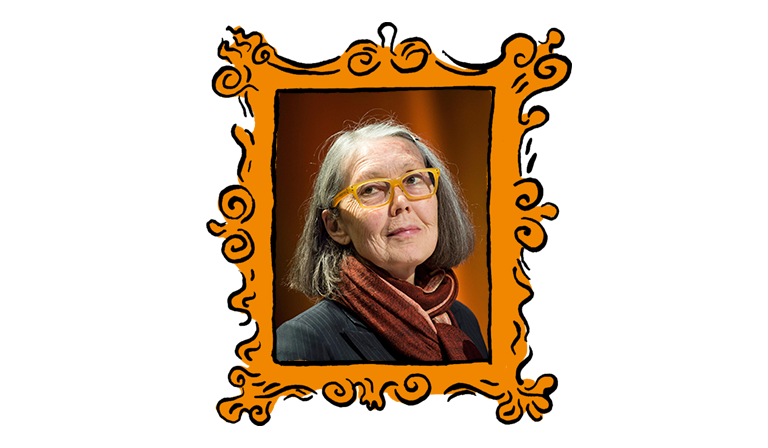
Anne Carson, Anne Carson. Oh, Where Have You Been All My Life?
Why does tragedy exist? Because you are full of rage. Why are you full of rage? Because you are full of grief.
– “Tragedy: A Curious Art Form”, Grief Lessons
Last week, the Swedish Academy rang a woman in Iceland and told her she had won the Nobel Prize in Literature. She was seventy-six years old. She said: “Crazy, they’re all crazy! I’ll get a sticker on the book.” Then she went back to listening to the wind – or cleaning the kitchen, depending on which version of this tale you choose to believe.
Her name is Anne Carson, and until recently I’d never read a word of her. Now I have a TBR pile and I’m flitting from book to book, like a kid at Christmas spoiled by choice.
Where have you been all my life, Anne Carson? The answer, it turns out, is: in Canada, in Iceland, and in ancient Greece – waiting for the rest of us to catch up.
The classics professor who writes like a poet
someone will remember us I say even in another time.
– Sappho, fragment 147, translated by Anne Carson, If Not, Winter
Carson was born in Toronto and has taught classics at McGill University, Princeton and Michigan. She is a scholar of Greek in the true sense: she translates Sappho, Euripides and Sophocles, and her translations are considered poems in their own right. But she has spent her career making things that refuse to sit within genre. Verse novels. Essays that break into poetry halfway through. A libretto. An elegy in the form of a scrapbook. The Academy praised her bold, imaginative works, which create new forms through a playful engagement with the classical tradition.
The MacArthur Fellowship, the T.S. Eliot Prize, the Griffin Prize, the Lannan Literary Award – she has a mantelpiece the rest of literature envies. And still she has flown under the radar of most ordinary readers, myself included, precisely because she refuses every category we use to find things. You don’t stumble on Anne Carson in the bookshop. You have to be told.
Consider me told.
I’m starting here: Autobiography of Red
Apparently, if you only read one Carson, it should be this one. Published in 1998, it’s labelled “a novel in verse”, which is like labelling the sea “a large puddle”. It takes a forgotten fragment of the ancient poet Stesichoros – the story of Geryon, the winged red monster Herakles kills on his tenth labour – and turns it into the story of a modern boy with wings who falls in love with a drifter named Herakles, who breaks his heart and then, years later, reappears.
What is an adjective? Nouns name the world. Verbs activate the names. Adjectives come from somewhere else. The word adjective (epitheton in Greek) is itself an adjective meaning “placed on top,” “added,” “appended,” “imported,” “foreign.” Adjectives seem fairly innocent additions but look again. These small imported mechanisms are in charge of attaching everything in the world to its place in particularity. They are latches of being.
– Autobiography of Red
It asks what happens when you love someone who will ultimately destroy you. The whole book runs on that voltage. It is funny and strange and devastating, and it reads like nothing else, because it isn’t like anything else. Geryon takes photographs. The volcano in his chest is not a metaphor, or it is entirely a metaphor, or the book doesn’t care about your categories.
The heartbreak poem
Then there’s “The Glass Essay”, a long poem from 1995 about a woman whose lover has left her, alone on the Yorkshire moors with her mother and the ghost of Emily Brontë. It opens:
I can hear little clicks inside my dream. Night drips its silver tap down the back.
If that doesn’t put a cold finger on your spine, check your pulse.
The Greece thread
Carson’s entire life’s work runs through the Greek myths: Sappho’s fragments, Helen of Troy, Herakles, Antigone, Geryon. She has spent her career walking around inside ancient Greek literature, prodding it, updating it, translating it so that scholars and poets both claim it as theirs. In Norma Jeane Baker of Troy she merges Helen of Troy with Marilyn Monroe, because both were women defined by their beauty and then destroyed by it.
Anne Carson did all of this from Canada, the United States and, latterly, Iceland. There’s a lesson in that for anyone who writes. You don’t have to stand in the landscape to own the myth. Though if you’d like to stand in it anyway, we know a place: a Portara at sunset, tavernas for afterwards, a Venetian castle, and a former Ursuline convent where photographs of long-gone French nuns watch from the walls, and there’s a wine bar with views over the port.
Nox, and the woman herself
Nox is Carson’s elegy for her estranged brother, who died suddenly in Copenhagen. It’s a book that is an object: a facsimile of the scrapbook she made in his memory, an accordion of folded pages holding scraps of letters, dictionary entries, photographs. It’s the grief book of its generation. It made me feel better and it made me cry.
When Parkinson’s arrived in her seventies, Carson complained about her handwriting and took up boxing, a sport thought to help with coordination.
Where I’m starting (a very short guide)
Please join me so we can compare notes afterwards.
Autobiography of Red – the gateway drug. Novel in verse, monster in love, volcano in chest.
“The Glass Essay” (in Glass, Irony and God) – heartbreak, moors, Emily Brontë, the cold tap.
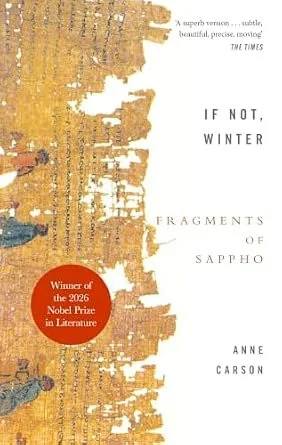
If Not, Winter – all of Sappho, fragments and all, the gaps left where the papyrus broke.
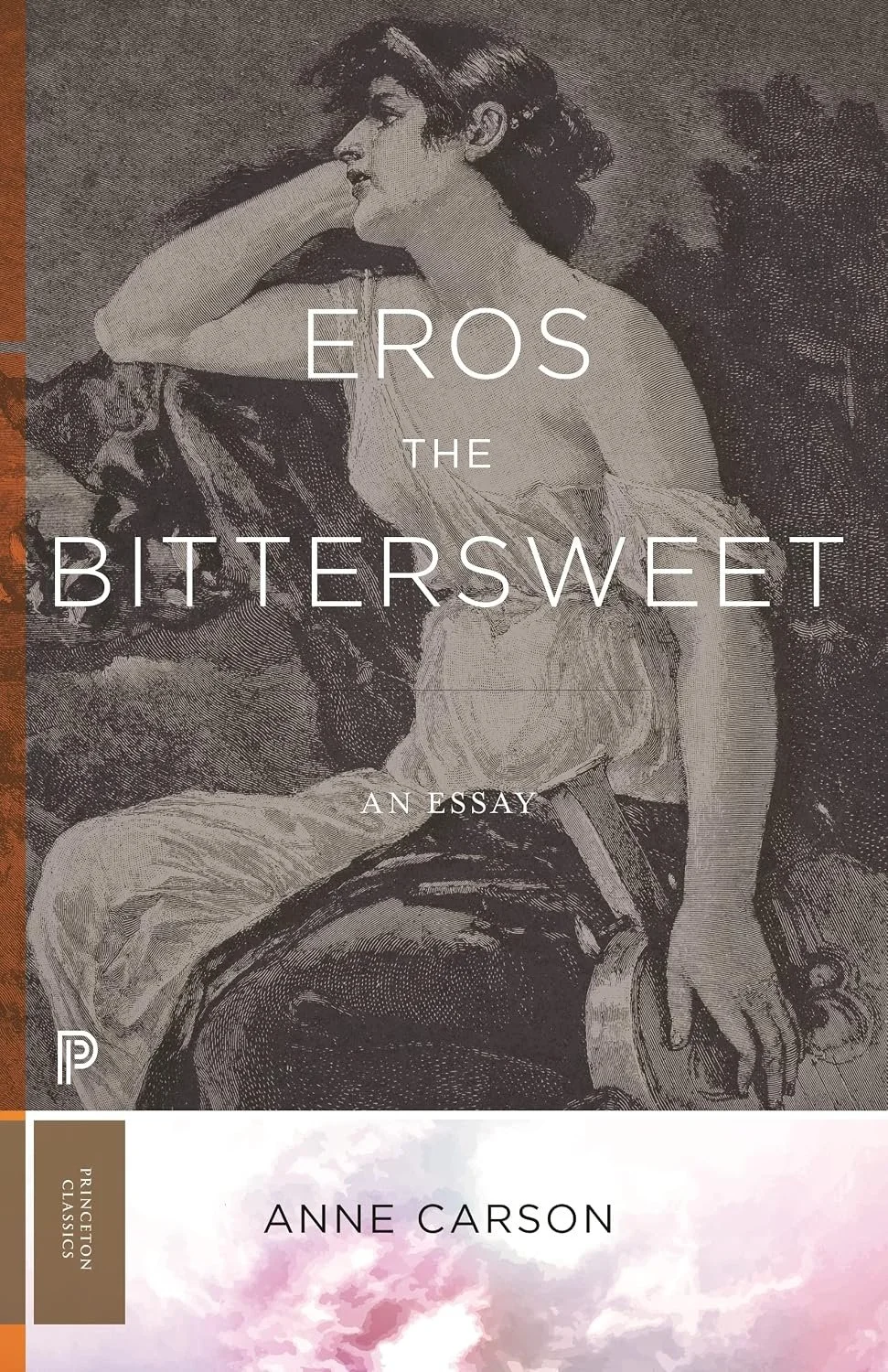
Eros the Bittersweet – her essay on desire.
Norma Jeane Baker of Troy – Helen meets Marilyn.
Nox. Of course.
Read them in that order and you’ll arrive where I hope to be in a couple of months: slightly disoriented, gloriously mesmerised, and annoyed at all the years spent without Carson on my bookshelf and in my head.
Anne Carson. Where have you been all my life? Waiting patiently in ancient Greece, of course. Some of the best company always is.
Nola