
Books, Books and Greek Salad: A Little Detour Through Frankfurt
Here at Naxos Creative, we welcome solo travellers with open arms. Which is why, when sitting at a table in a Kalamata restaurant last week, I didn't hesitate when the woman sitting alone at the table next to me asked if I'd like to join her.
Oh, joy! Dear reader - you'll be delighted to hear I'd stumbled across a fellow reader. We trotted dutifully through the weather (windy), Greece (wonderful, of course), Kalamata (great shopping), and what to order (Greek salad, fish soup and chicken soup, respectively) – and then galloped into talking books, books and all things books. My new friend is German, and as it was the week after the Frankfurt Book Fair, it was only natural that our conversation should take a little detour through Frankfurt.
Frankfurt Book Fair. Let me start with a confession. I've heard all about the book fair, and we take it into account when planning our October retreats, I’ve been to Frankfurt and I’ve even had a book do the rounds (alas, unsuccessfully) at the fair, but I've actually never been to Frankfurt Book Fair myself. It's one of the great publishing wingdings held annually, alongside the likes of Beijing and London, where anyone who's anyone in publishing meets to do deals, sell books, gossip, eat, drink and make literary merry.
Behind all that literary merrymaking, of course, are the books themselves. And behind the books are writers, some of whom have been waiting a very long time for somebody to say yes.
So why a blog about Frankfurt '26, I hear you ask (you're probably too polite to add especially as you've never even been there)? I have two perfectly valid reasons. A very good friend of mine got his first ever book deal (looking at you, Miles!) and because of a book we discussed over Greek salad and homemade soup at that table in the Kalamata restaurant.
One reason for a celebration, then, and another for adding to the reading pile. A productive supper, I'd say.

The book is called Die Lücken, by Shida Bazyar, and it won the 2026 German Book Prize, presented in Frankfurt. The prize's English-language site translates the title as Omissions.
It follows nearly a century of life in a fictional German village, connecting its suppressed Nazi past with the arrival of an Iranian refugee family. The jury praised it as "a novel that stands against indifference".
Now there's a recommendation to make you sit up and pay attention.
The village is Heimesbach, in the Hunsrück, and the story moves between generations, between people who have always belonged there and people hoping to make it their home. Beneath the appearance of ordinary village life are histories that haven't been acknowledged, let alone reckoned with. People have disappeared. Others have benefited. Life has carried on.
You can read the jury's full comments here, but what caught my attention was the question at the heart of their assessment: is it possible to feel at home in Heimesbach? Who gets to belong, and who gets to decide?
These are enormous questions. But put them into a street, a house, a conversation between neighbours, and suddenly they become terribly close. Who says hello? Who looks away? What do the children know about the people next door? What have the adults decided not to tell them?
I should be clear: this isn't a review of the novel. I haven't read the whole book, and a conversation over lunch, however enthusiastic, doesn't qualify me to deliver a verdict. This is one reader passing on a discovery to other readers. With a certain amount of excitement.
And there's an English-language extract, translated by Ruth Martin, so you can have a look for yourself without waiting to get your hands on a complete English edition – when it comes out.
The opening gives us a narrator who is already dead, addressing someone called Lu. Before we settle into the village's history, we're asked what knowing that history might have changed. Would the family have behaved differently? Would they have looked differently at the houses, the neighbours, the familiar places they passed every day?
It's an unsettling invitation. We generally like to think we'd have asked the questions, noticed the signs, said something. This narrator is rather less reassuring about that.
Then we move back to the 1920s and a young woman called Johanna, who has fallen in love. There are childhood friendships, school benches, village games, the physical fury of being young and having nowhere to put your feelings. The history comes with people attached. People who have bodies and tempers and secrets, rather than simply dates beside their names.
That, for me, is the pull of the extract. Knowing where a period of history is heading doesn't mean we know how it felt to live an ordinary day inside it. Fiction can take us into that day, sit us down beside someone and make it considerably harder to keep our distance.
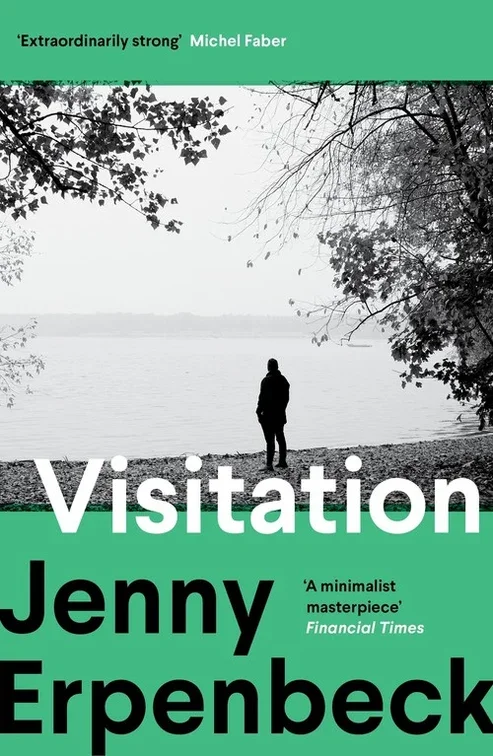
From the extract, I found myself thinking of Jenny Erpenbeck's Visitation, with its layers of German history held in one place, and her Go, Went, Gone, which asks what it really means to be allowed to belong. There's something, too, of Claire Keegan's Small Things Like These in the things a community chooses not to see, while the dead narrator brings to mind Han Kang's Human Acts. Different books, but if any of these lives on in your head, this is one to keep an eye on.
Which brings me back to the restaurant.
There is something exhilarating about meeting a reader whose bookshelves aren't the same as your own. You can spend a very happy hour discovering books you both love. But then comes the title you've never heard of, the author who hasn't crossed your path, the recommendation you wouldn't have found by browsing your usual shelves.
Thank you, Frankfurt!
It's one of the pleasures of reading across languages, even when we need a translator to do the travelling for us. There are whole literary conversations happening elsewhere, with their own familiar names, arguments and enthusiasms. Every now and then, someone at the next table opens a door into one of them.
A prize can do that too. You don't have to agree with every jury or regard a winner as homework. But a prize announcement can be the nudge that sends you towards a book you'd otherwise have missed. An extract lets the writing have its say.
As for Miles and that first book deal: there is a particular thrill in seeing a friend reach that moment. Anyone who has sent a manuscript out into the world knows that the waiting can be quite something. So, when the good news comes, yes, there should be a fuss. Preferably a considerable one. Frankfurt, from my admittedly distant vantage point, has supplied both things this year: a friend's reason to celebrate and a stranger's reason to recommend a book. And that’s the pleasure of an unplanned conversation. Not every solo lunch needs to become a social occasion. Sometimes you want your own table and your own book, and quite right too. But sometimes an invitation from the next table leads somewhere you hadn't expected.
Here at Naxos Creative, we rather like the thought of people arriving on their own and finding someone to talk books with. No need to have read the same things. In fact, all the better if you haven't.
So, dear reader, have a look at the extract. Tell me what you think. And if there's a book from another country, another language or simply another reader's shelf that I really ought to know about, do tell.
There is always room for one more book. Shelf space is another matter entirely.
Nola