
Kitron: The Naxos Liqueur You've Never Heard Of (But Will Never Forget)
Every Greek island seems to have something it quietly claims as its own. Naxos has its potatoes, its wonderful cheeses, its honey, its wine — and then there is Kitron.
Unless you've spent time on Naxos, there is a good chance you've never heard of it. But once you've tasted it, you'll probably remember it.
Kitron is Naxos's distinctive citrus liqueur, made not from lemons — and, rather surprisingly, not primarily from the citron fruit either — but from the fragrant leaves of the citron tree (Citrus medica). The leaves contain intensely aromatic essential oils which give the drink its characteristic fresh, slightly herbal citrus flavour.
The citron itself is an extraordinary-looking thing: large, knobbly and rather more substantial than a lemon. Citron trees have been cultivated on Naxos for centuries, thriving particularly in the fertile valleys and plains of the island. At one time the fruit was an important Naxian export; today it is also used to make traditional Greek spoon sweets.
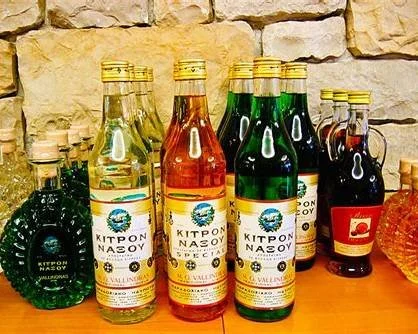
From kitrorako to Kitron
Long before Kitron became the polished liqueur you'll now see lined up in bottles behind Naxian bars, islanders were using citron leaves to flavour their local raki. The resulting drink was known as kitrorako.
During the second half of the 19th century, the Vallindras family began developing this local tradition into something more refined. Grigorios Vallindras established a small distillery in Halki, and in 1896 his son Markos developed the business further, producing the citron liqueur recognisable today. And Kitron wasn't always Naxos's little secret. It travelled to Greek communities in Russia, Egypt, the United States and Asia Minor and collected international awards along the way, including gold medals in Marseille in 1904 and Bordeaux in 1907.
Quite a history for a drink many visitors have never encountered before arriving on the island.
How is it made?
The citron leaves are gathered when their perfume is at its strongest, usually from around September and through the winter.
They are carefully selected and placed with alcohol in traditional stills. During distillation, the essential oils held within the leaves pass into the spirit, producing that unmistakable citron aroma.
The result comes in three traditional versions: green, clear and yellow.
And the colours aren't simply decorative.
Traditionally, green is the sweetest and lowest in alcohol, at around 30%; clear is a little stronger and drier, at around 33%; and yellow is the strongest and driest, at around 36%.
If you're doing a tasting, trying all three is therefore entirely in the interests of research.
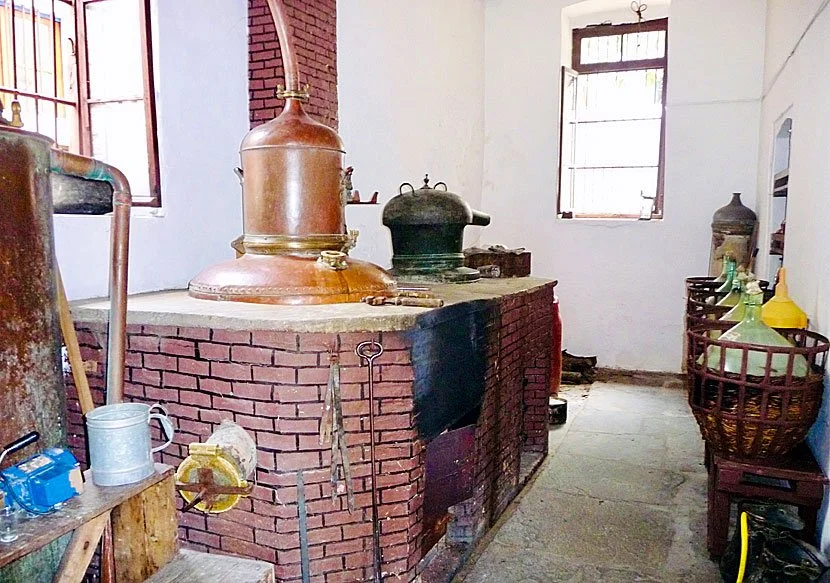
A little piece of old Naxos
One of the loveliest places to discover Kitron is the old Vallindras Distillery in Halki, in the heart of the island.
Halki itself feels very different from the beach villages: neoclassical houses, little lanes, cafés beneath the trees and the mountains rising behind it. Inside the Vallindras distillery, which remains in the family and is now run by the fifth generation, you can see old bottles, labels, advertisements and distilling equipment — including equipment dating back to 1862.
It is part distillery, part family history and part glimpse into a Naxos that existed long before beach bars and ferry timetables. And, importantly, you can taste the Kitron. Another long-established Naxian producer is Promponas, whose family business began making and bottling Kitron in 1915 and continues the tradition today.
What does Kitron taste like?
This is harder to describe. Imagine citrus, but not the sharp acidity of lemon juice. It is aromatic rather than sour: lemony, floral, slightly herbal and, depending on which version you drink, either gently sweet or surprisingly dry.
Served cold after dinner, it makes a wonderful digestif. Increasingly, you'll also find Naxos bars using Kitron in cocktails — an excellent excuse to investigate several versions during the course of a holiday.
But perhaps part of Kitron's appeal is that it still feels so deeply connected to this one island.
Naxos Kitron has Protected Designation of Origin status, meaning its identity is legally tied to Naxos. It is one of the island's true local products rather than something manufactured elsewhere and given a Greek-looking label.
One more thing to look for when you're here
When you're driving through the greener interior of Naxos, particularly around the fertile valleys, look out for the citron trees themselves.
It is easy to concentrate on the dramatic mountains, ancient olive trees and brilliant white villages and miss the quieter agricultural landscape underneath them. But Kitron tells part of that story too.
A tree cultivated here for centuries. Leaves gathered when their scent is strongest. A family distillery in Halki. A drink that travelled from Naxos to communities all over the world — and somehow still feels like a secret when somebody pours you your first glass.
So when you come to Naxos, try the wine. Eat the cheese. Order the potatoes.
But before you leave, find yourself a little glass of Kitron.
Yamas.