
Greek Mythology and Naxos: The Island Where the Gods Came to Life
On Naxos, mythology does not feel confined to the pages of an ancient book. It is written into the mountains, hidden inside caves and scattered among marble ruins. It appears in the island’s vineyards, its wild landscape and the great stone doorway that greets every traveller approaching Naxos by sea.
This is an island where gods were raised, princesses were abandoned and unlikely love stories began. Even today, it is easy to understand why the ancient Greeks imagined that divine events had taken place here.
Ariadne, Theseus and the Shores of Naxos
Perhaps the best-known Naxian myth is the story of Ariadne.
Ariadne was the daughter of King Minos of Crete. When the Athenian hero Theseus arrived in Crete intending to kill the Minotaur, Ariadne fell in love with him. She gave him a ball of thread so that he could find his way out of the labyrinth after defeating the creature.
Theseus escaped with Ariadne, and together they sailed away from Crete. During their journey, however, they stopped on Naxos. It was here that Ariadne awoke to discover that Theseus and his ship had gone.
Why Theseus left her depends upon which version of the myth you read. In some accounts, he abandoned her deliberately. In others, the gods ordered him to leave because Ariadne was destined for someone else.
Whatever the reason, Ariadne was left alone on the shore of Naxos.
It should have been the tragic end of her story. Instead, it became a new beginning.
Dionysus and Ariadne: A Divine Love Story
Dionysus, the god of wine, theatre, celebration and transformation, found Ariadne on Naxos and fell in love with her.
He made her his wife and, according to one version of the story, gave her a golden crown as a wedding gift. After her death, the crown was placed among the stars as the constellation Corona Borealis.
The marriage of Dionysus and Ariadne became one of the great love stories of Greek mythology. It also established a lasting connection between Dionysus and Naxos. The island’s official tourism history describes their marriage as one of the central myths associated with Naxos.
The association feels particularly fitting. Dionysus was not merely the god of wine and revelry. He was also the god of theatre, imagination and the freedom to become someone else.
Anyone arriving on Naxos for a creative retreat may therefore feel that they have chosen the right island. Stories, performance and transformation have belonged here for thousands of years.
The Portara: A Doorway Between Worlds
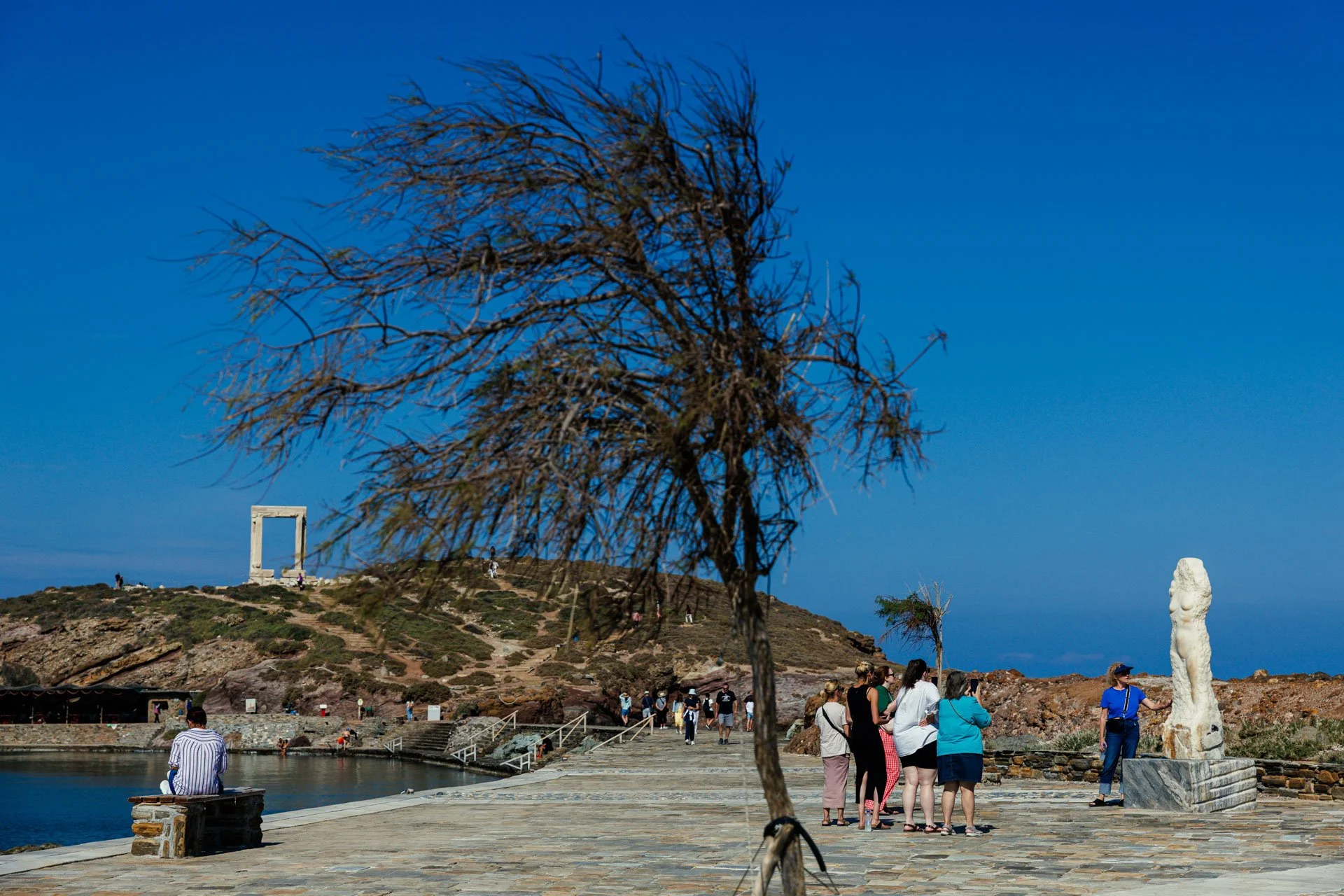
The most famous landmark on Naxos is the Portara, the enormous marble doorway standing on the small islet of Palatia beside Naxos Town.
It is all that remains of an unfinished temple begun during the sixth century BC and traditionally associated with Apollo. Standing alone against the sea and sky, it looks less like a ruin and more like an entrance into another world.
Palatia is also linked in popular tradition with the story of Ariadne. It is often identified as the place where she was abandoned by Theseus before being discovered by Dionysus.
At sunset, crowds walk across the causeway to watch the sun descend behind the Portara. The light turns the marble gold, the sea darkens and the surrounding islands become silhouettes on the horizon.
It is one of the most beautiful sights in the Cyclades—but it is also wonderfully theatrical. The doorway frames the changing sky like an enormous stage.
The Sanctuary of Dionysus at Yria
Zeus and the Mountain of the Gods
Naxos is not connected only with Dionysus. The island also claims an important place in the childhood of Zeus, king of the Olympian gods.
According to Naxian mythology, Zeus was born on Crete but brought to Naxos to be raised in safety, hidden from his father Cronus. He spent his childhood in a cave on the mountain that now bears his name: Mount Zas.
Rising above the village of Filoti, Mount Zas is the highest mountain in the Cyclades, reaching approximately 1,003 metres. Local mythology says that an eagle presented Zeus with the thunderbolt that would eventually help him become ruler of the gods.
Today, it is possible to walk to the Cave of Zas or continue to the mountain’s summit. The landscape becomes increasingly rugged as you climb, with rocky paths, herbs, grazing goats and extraordinary views across Naxos and the surrounding islands.
The cave is cool and shadowy, in dramatic contrast to the bright mountainside outside. Whether or not you believe a young god once sheltered there, it is a place that naturally inspires stories.
The Sanctuary of Dionysus at Yria
The connection between Dionysus and Naxos was not purely mythological. He was actively worshipped on the island.
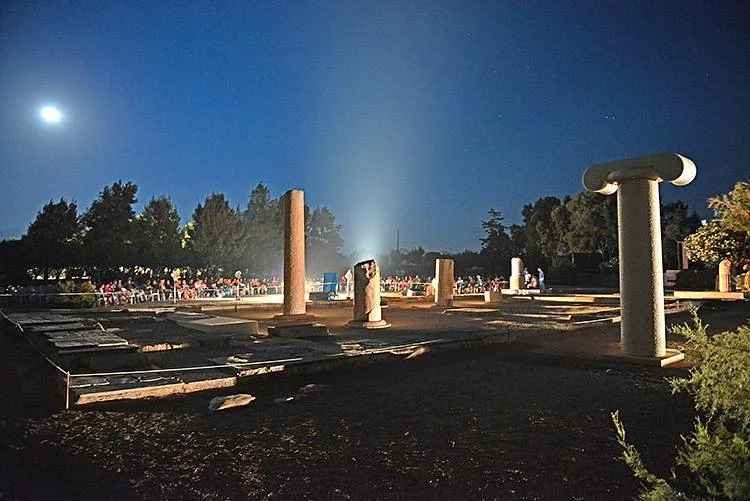
Near the village of Glinado, in the fertile area of Yria, lie the remains of an ancient sanctuary dedicated to him. The site developed over many centuries, and successive temples were built there as religious practices and architectural techniques changed.
The location seems entirely appropriate for Dionysus. This is a lush agricultural part of Naxos, surrounded by land that has supported vines, fruit trees and farming for generations.
The sanctuary is quieter than many of the island’s more famous attractions. Visitors can walk among the remaining columns and foundations while imagining ceremonies, music and celebrations taking place in the same landscape thousands of years ago. Archaeological work at Yria was undertaken through collaboration involving the University of Athens, the Technical University of Munich and Greek authorities.
Come for the beaches, the food and the warm Aegean light. But leave space for the myths.
On Naxos, they never feel very far away.